
eSignature audit trail: What it is, how it works, and why it protects your business

An eSignature audit trail is a secure, time-stamped, and sequential digital record of all events and actions related to a document’s signing process, providing the evidence needed to help prove its integrity, legal validity, and legal enforceability.
Think of it as a certified digital logbook. Every time someone opens, views, or signs a document, an entry is made. The result is a clear chain of evidence and a detailed record of the electronic signature process. It is similar to having a notary present for every step of a transaction. The only difference is that the record is automatic, tamper-evident, and stored securely. For businesses moving away from paper-based processes, this kind of digital audit trail helps support legal compliance, data integrity, and workflow efficiency.
TL;DR: What you need to know about electronic signature audit logs
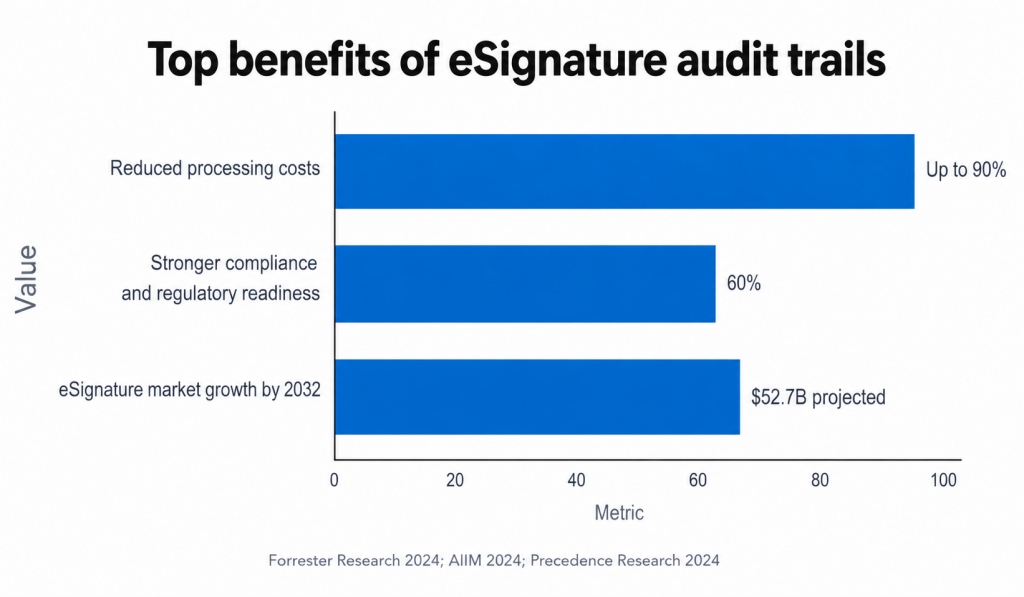
- The global eSignature market is projected to reach $52.7 billion by 2032, driven largely by the demand for verifiable eSignature audit trails (Precedence Research, 2024).
- Secure signing workflows with audit trails can reduce document processing costs by up to 90% (Forrester Research, 2024).
- Enterprise-grade eSignature platforms are expected to deliver a “Certificate of Completion” — a human-readable summary of the full audit log or audit report — as a standard feature (Gartner, 2025).
Why does an eSignature audit trail matter?
An eSignature audit trail matters because it provides the legally admissible proof required to help validate a digital transaction, mitigate risk, and support legal compliance. Without it, an electronic signature may lack the evidentiary weight needed in legal proceedings, dispute resolution, or other situations.
Two pain points come up consistently in practice. First, proving a signer’s identity and intent is difficult when all you have is an email address. A proper signature audit captures authentication events, that go far beyond “someone with this email clicked a button.” Second, organizations worry that a document or its history could be altered after signing. A tamper-evident audit log addresses this directly. Any modification to the record breaks the cryptographic chain, making tampering immediately detectable and helping preserve the document’s integrity.
IDC (2024) identifies verifiable audit trails as a cornerstone of digital trust and transparency. For organizations operating under legally binding eSignatures requirements, the audit trail is not optional. It is true for both organizations under US federal law, eSignature laws in the European Union, or sector-specific rules. It is the mechanism that helps transform a digital signature from a convenience into a legally binding and defensible act. In practice, audit trails serve as a comprehensive record of the parties involved, the actions taken, and the timing of those actions. This gives businesses, compliance teams, and legal experts the clear evidence they need to support legal recognition and resolve disputes.
How does an eSignature audit trail work?
An eSignature audit trail works by automatically and sequentially capturing every interaction with a document in a secure, time-stamped log. The log starts from the moment a document is prepared for signing through to final archiving. In a modern electronic signature system, this secure audit trail becomes part of the document’s permanent history.
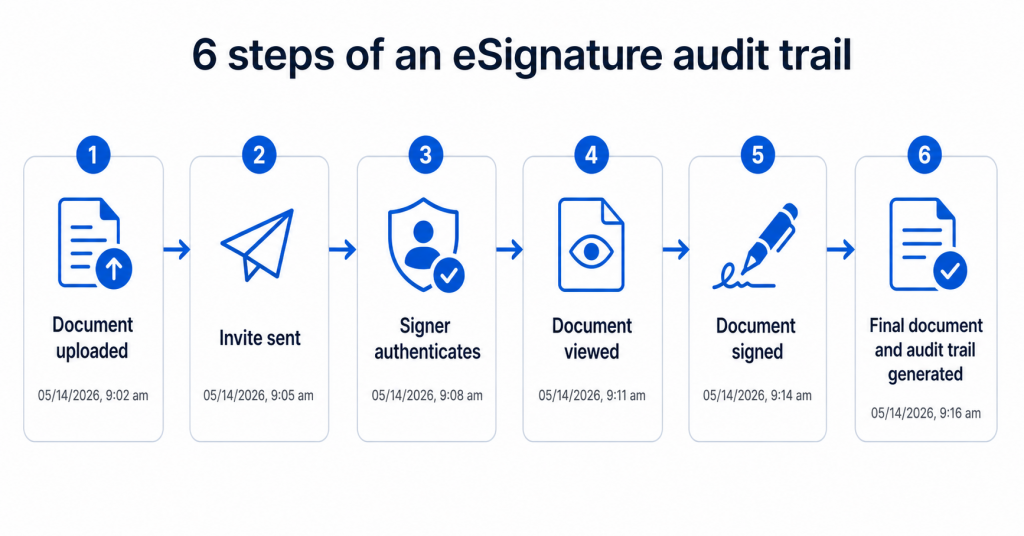
How the process of eSignature audit trail unfolds in SignNow
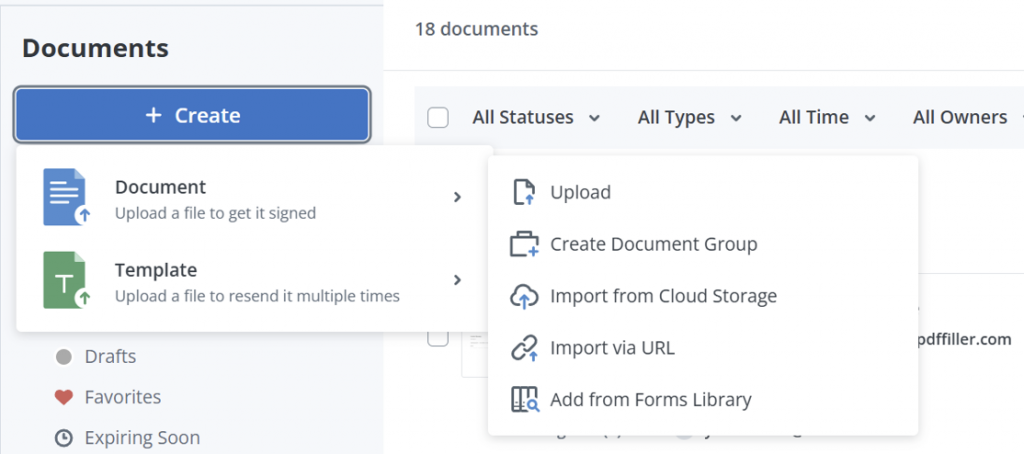
1. Document uploaded and prepared.
The sender uploads a document to SignNow and adds the fields needed for signing, such as signature, date, text, or checkbox fields. SignNow records the start of the workflow and ties activity to that document throughout its lifecycle.
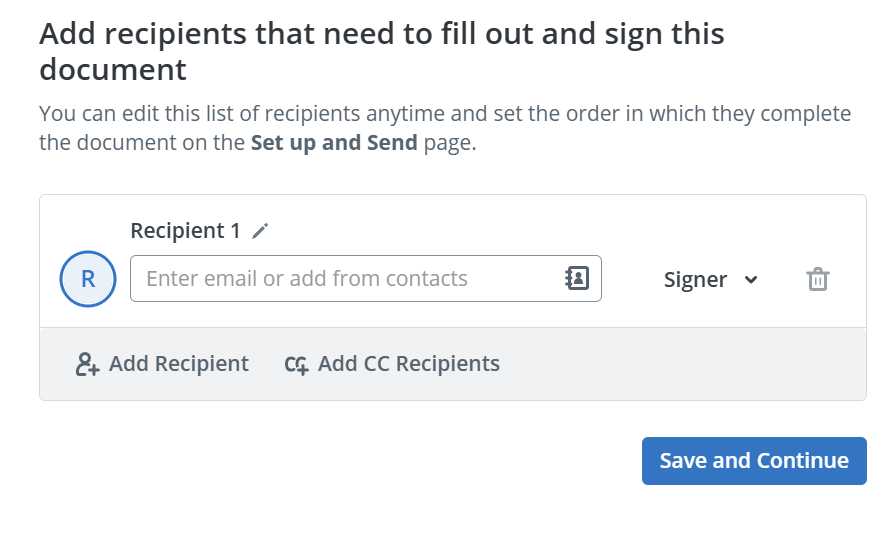
2. Recipients added and invite sent.
The sender adds one or more recipients, sets the signing order if needed, and sends the document for eSignature. SignNow logs the send event, including recipient details, sender information, and the time the invitation was sent.
3. Signer accesses and verifies.
When the recipient opens the signing request, SignNow records that access event. If extra verification is enabled, SignNow also logs the authentication method used, such as a password or SMS code, along with signer details like IP address and device information.
4. Document reviewed.
As the signer views the document, SignNow captures that step in the audit trail. This helps show that the person signing had the opportunity to review the electronic document before completing the signature process.
5. Document signed.
When the signer completes the required fields and signs, SignNow records the action with a timestamp, signer details, and the relevant document event history. This creates a secure, time-stamped record within the electronic signature audit trail.
6. Completed document stored with audit trail.
After all required parties have signed, SignNow finalizes the document, and the full audit trail is accessible under the History option. The completed file and its audit record can then be stored, downloaded, shared, or referenced later for legal compliance, dispute resolution, or internal review.
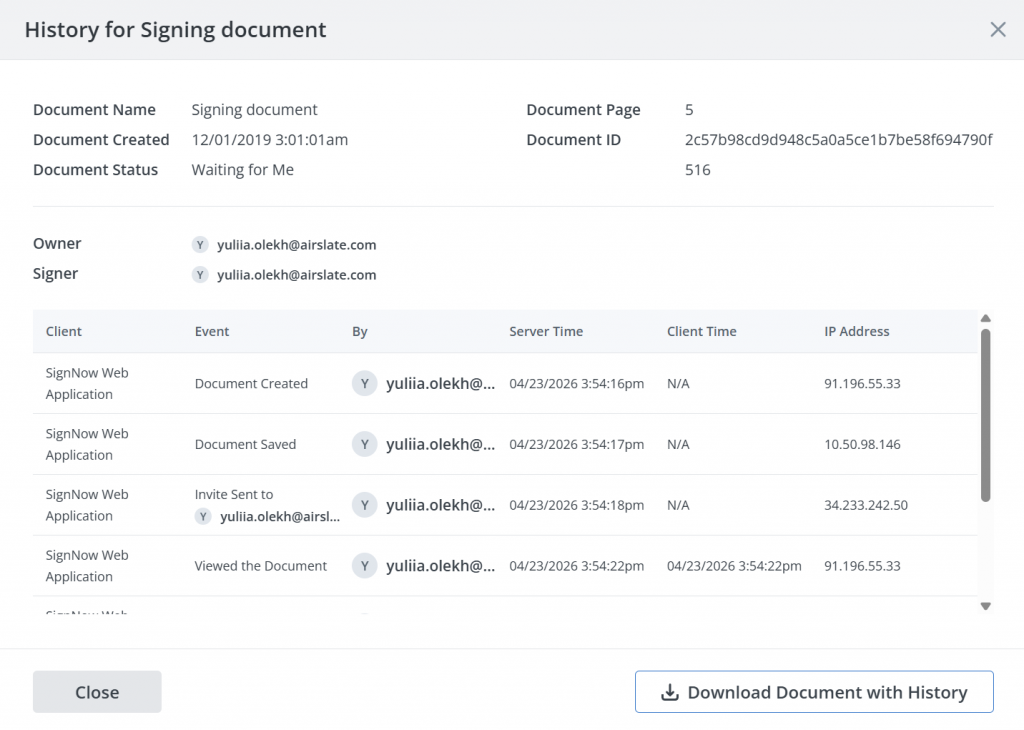
eSignature audit trail: The technical explanation
From the technical side, each log entry is linked to the previous one using cryptographic hashing (Journal of Digital Forensics, Security and Law, 2024). If anyone attempts to alter any entry in the sequence, all subsequent entries become invalid. In this way, unauthorized modification is detectable without manual inspection. In some forms of digital signing, this protection can also work alongside public key infrastructure to strengthen identity assurance and trust in the signed file.
Looking ahead, Gartner (2025) notes increased adoption of AI to analyze audit trail data in real time for fraud detection. Identifying anomalous signing patterns, such as a document being signed from two geographically distant locations within minutes, helps.
Key components of a comprehensive audit trail
A robust eSignature audit trail contains several critical data points that together create a complete and defensible record of the signing event. These components go far beyond a signature image or handwritten signatures to provide deeper context and a full audit trail.
- Full signer identity data. SignNow captures full names and email addresses for every participant, creating a clear record of who was involved in the transaction. This helps support identity verification and gives teams access to essential signer details.
- IP addresses and device information. Every action is tied to the IP address and user agent string of the device used, providing location and device context that is important for identity verification in disputes.
- Sequential timestamps. Every event is recorded with a precise timestamp, creating an ordered, unalterable document signing history.
- Unique document ID. Each unique document is assigned an identifier that persists throughout its lifecycle, making it possible to trace any copy of the document back to its original signed version.
- Two-factor signer authentication record. When two-factor authentication is used, the audit log records that the signer completed this step, adding an additional layer of identity proof.
- Locked signing date and Certificate of Completion. The signing date is locked at the moment of execution and cannot be altered retroactively. SignNow packages the full audit log into a Certificate of Completion — a readable PDF summary appended to the signed document.
eSignature audit trail vs. digital signature certificate
An eSignature audit trail and a digital signature certificate serve different functions: the audit trail documents the signing process, while the digital signature certificate provides cryptographic proof of the signer’s identity at the moment of signing.
These two elements are complementary. A platform like SignNow can support certificate-based signing while also maintaining the audit trail as a separate, sequential record of every event. In some workflows, public key infrastructure supports the certificate layer, while the eSignature audit captures the activity across the signature process.
| Feature | eSignature audit trail | Digital signature certificate |
| Purpose | Records the full history of the signing process | Proves the signer’s identity cryptographically |
| Content | Timestamps, IP addresses, actions, signer names | Public/private key pair, certificate authority data |
| Source | Generated by the eSignature platform | Issued by a Certificate Authority (CA) via PKI |
| Legal function | Provides process evidence for admissibility | Provides identity assurance and non-repudiation |
| Analogy | A notary’s logbook of events | A government-issued ID presented at signing |
Both are important for a more defensible electronic signature process. The certificate helps confirm who signed; the audit trail confirms what happened before, during, and after signing. Together, they support enhanced security, stronger legal recognition, and a more reliable record for business transactions involving electronic records.
Who uses eSignature audit trails?
Virtually any organization that requires legally binding agreements uses eSignature audit trails, but they are especially important in regulated industries where the standards are higher.
Healthcare — HIPAA compliance
- Who: Hospital systems, private practices, telehealth providers
- What: Patient intake forms, consent documents, treatment authorizations
- Where: Across desktop and mobile devices, including in-clinic kiosks
- When: At every patient interaction requiring written consent
- Why: HIPAA‘s “Audit Controls” requirement (45 CFR §164.312) mandates that covered entities implement hardware, software, and procedural mechanisms to record and examine access to electronic protected health information. An audit trail helps satisfy this requirement directly.
- How: SignNow captures document history and stores it securely in compliance-ready workflows (available as an add-on via Business Associate Agreement).
Life sciences — 21 CFR Part 11
FDA regulations under 21 CFR Part 11 require that electronic records include time-stamped audit trails with the date and time of operator entries and actions that create, modify, or delete electronic records. For pharmaceutical and biotech companies managing clinical trial documentation, a non-compliant audit trail can jeopardize a submission. SignNow’s 21 CFR Part 11 compliance includes two-factor authentication, session timeouts, eSignature timestamps, and document history retention.
Legal services — ESIGN/UETA
Legal teams, law firms, and legal service providers send contracts, NDAs, and settlement agreements to multiple signers in a defined signing order. The ESIGN Act and UETA
Financial services — ESIGN/UETA and SOC 2
Finance teams completing tax forms, invoices, and loan documents need both speed and an auditable record. SignNow’s SOC 2 Type II certification means its audit trail infrastructure has been independently assessed for security and availability controls.
Benefits of a robust eSignature audit trail
Implementing an eSignature solution with a robust audit trail delivers benefits beyond convenience, including stronger legal support, compliance coverage, and operational efficiency.
- Enhanced legal defensibility. A detailed audit trail supports the burden of proof required under the ESIGN Act, UETA, and eIDAS. It documents not just the signature but the full context of the transaction — who was invited, when they viewed the document, and how they authenticated. This creates sufficient evidence for many common compliance and enforcement scenarios.
- Streamlined regulatory compliance. 21 CFR Part 11 explicitly requires “time-stamped audit trails.” HIPAA’s Audit Controls standard requires mechanisms to record access to electronic health information. A compliant audit trail helps address both requirements without additional manual record-keeping.
- Reduced document processing costs. Forrester Research (2024) found that secure signing workflows with audit trails can reduce document processing costs by up to 90% compared to paper-based alternatives.
- Stronger security posture. Tamper-evident logging using cryptographic hashing makes unauthorized modifications to the audit record immediately detectable (Journal of Digital Forensics, Security and Law, 2024). SignNow securely manages data using encryption at rest and in transit.
- Documented non-repudiation. By linking authentication events to signing actions with precise timestamps, the audit trail creates evidence that a specific individual executed a specific document at a specific time.
Final thoughts: Secure your agreements with SignNow’s detailed audit trail
SignNow includes audit trails with completed documents, along with a Certificate of Completion that captures signer names, email addresses, IP addresses, authentication events, and locked timestamps. The platform supports secure, scalable document workflows and offers compliance-focused features for teams with advanced requirements. For organizations that need to sign documents online while maintaining a bulletproof record, SignNow is the proper solution. It helps bring together the full audit trail, electronic documents, and the controls needed for efficient, accountable digital transactions.
Start your free trial of SignNow today and see what a complete, tamper-evident document signing history looks like in practice.
Glossary
eIDAS: (Electronic Identification, Authentication and Trust Services) An EU regulation governing electronic identification and trust services for electronic transactions within the European Union. It establishes legal frameworks for simple, advanced, and qualified electronic signatures.
ESIGN Act: (Electronic Signatures in Global and National Commerce Act) A US federal law enacted in 2000 that establishes the legal validity of electronic signatures and records in interstate and foreign commerce.
Non-repudiation: The assurance that a party cannot deny the validity of their signature or the authenticity of a document they signed. In electronic signature systems, non-repudiation is achieved through a combination of authentication records and tamper-evident audit logs.
Timestamping: The process of securely recording the date and time an event occurred, typically sourced from a trusted third-party Time Stamping Authority (TSA). Trusted timestamps are important for establishing the timing of a signing event.
UETA: (Uniform Electronic Transactions Act) A US state-level law adopted by 49 states that provides a legal framework for electronic signatures and records.
FAQ
Is an eSignature audit trail legally admissible in court?
Yes. Under regulations like the ESIGN Act and UETA in the United States, and eIDAS in the European Union, a well-maintained electronic record and its audit trail are legally admissible. They are evidence of a transaction. The strength of this evidence in court depends on the completeness of the record. Platforms that capture details like IP addresses, authentication events, and cryptographically linked timestamps provide a more robust audit trail. SignNow includes comprehensive audit trails for all completed documents, regardless of your plan.
What information is included in an eSignature audit trail?
For a complete audit trail, an electronic signature log should capture key details for every event in a document’s lifecycle. This includes the full names, email addresses, and IP addresses of all signers, as well as their device information (user agent strings) and secure, sequential timestamps. SignNow enhances this by also recording the authentication method for each signer and assigning a unique, persistent ID to every document for lifetime tracking.
How does an audit trail support non-repudiation?
Non-repudiation means a signer cannot credibly deny having signed a document. The audit trail supports this by creating a verifiable chain of evidence: it records that a specific email address received an invite, that the recipient authenticated their identity, that they opened the document, and that they executed the signature. According to IEEE Transactions (2024), this linked sequence of authenticated events is the technical foundation of non-repudiation in electronic signature systems.
What is the difference between an audit trail and a Certificate of Completion?
They contain the same information presented in different forms. The audit trail is the underlying sequential log of all events, stored securely within the platform. The Certificate of Completion is a human-readable PDF summary of that log, typically appended to the signed document for easier reference, sharing, and verification. Gartner (2025) identifies the Certificate of Completion as a standard expectation for enterprise-grade eSignature solutions. In SignNow, both are generated automatically when a document is fully executed.
Sources
- E-Signature Market Size Report — Precedence Research, 2024
- Forrester Research, 2024
- Information Governance Survey — AIIM, 2024
- IEEE Standard for Trusted Data Circulation, 2024

- Gartner, 2025
- Journal of Digital Forensics, Security and Law, 2024
- IDC, 2024
- ESIGN Act — Federal Trade Commission
- 21 CFR Part 11 Electronic Records and Signatures — FDA
- TL;DR: What you need to know about electronic signature audit logs
- Why does an eSignature audit trail matter?
- How does an eSignature audit trail work?
- How the process of eSignature audit trail unfolds in SignNow
- Key components of a comprehensive audit trail
- eSignature audit trail vs. digital signature certificate
- Who uses eSignature audit trails?
- Benefits of a robust eSignature audit trail
- Final thoughts: Secure your agreements with SignNow’s detailed audit trail
- Glossary
- FAQ
- Sources